
Methodology
AI Color Analysis
Free, instant, accurate. Upload a selfie; get your 12-season palette in 20 seconds. Here is exactly how it works — and why we think it holds its own against a professional draping session.
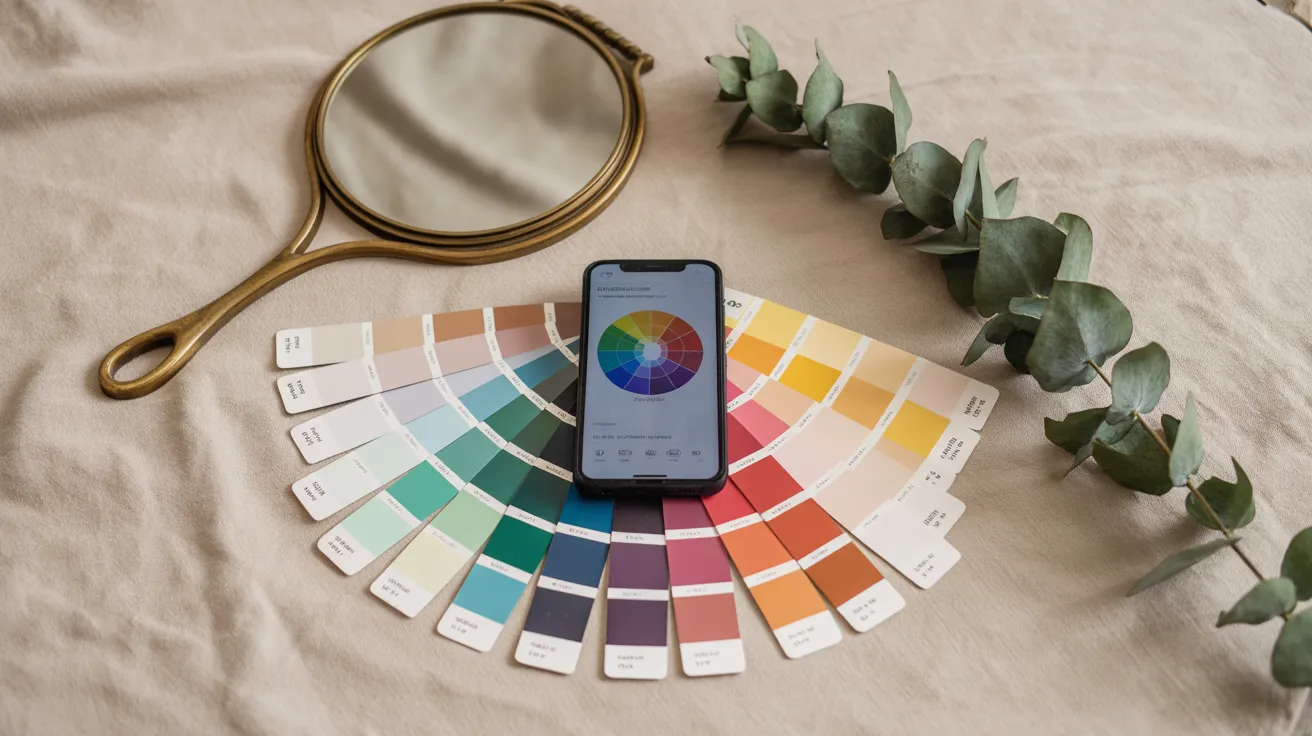
What AI color analysis actually is
AI color analysis uses computer vision models to extract three measurable signals from a selfie — depth (how light or deep your overall coloring is), undertone (cool, neutral, or warm), and contrast (low, medium, or high between hair, skin, and eyes). Those three signals classify you into one of twelve seasonal color palettes in the Sci\ART 12-season system, which every serious modern colorist uses. The AI returns your season, a 12-color palette with specific hex codes, best neutrals, colors to avoid, and 6 portrait variants showing you in different palette colors. The entire process runs in about 20 seconds per upload.
The three signals — what the AI reads
Signal 1
Depth
The combined lightness or darkness of your hair, skin, and eyes. AI computes this from luminance histograms of the skin and hair regions. Three levels: light, medium, deep.
Signal 2
Undertone
The warm vs cool cast of your skin. AI samples skin regions, corrects for lighting temperature, and classifies on a cool/neutral/warm axis. Five gradations: cool, cool-neutral, neutral, warm-neutral, warm.
Signal 3
Contrast
How different your hair, skin, and eyes are from each other. AI measures pairwise luminance and hue deltas between the three regions. Three levels: low, medium, high.
Read the deeper explanation: depth, undertone, and contrast — the three signals.
How accurate is AI color analysis?
| Method | What to expect | Time | Cost |
|---|---|---|---|
| Professional draping | A person compares real fabric beside your face | Ask your provider | Varies by provider |
| AI photo analysis (this tool) | A photo-based estimate; no published accuracy benchmark | Usually 30–90 seconds | Free basic analysis |
| General-purpose AI prompt | Depends on the model, prompt and photo | Varies | Depends on the service |
| Self-test with fabric | Useful for comparing colors; sensitive to lighting and judgment | At your own pace | Use clothing you own |
We have not published a controlled comparison with professional colorists. No accuracy percentage is established for this tool. Use the palette as a starting point and compare real fabrics in daylight.
What to upload for best results
+ Do
- · Natural daylight near a window
- · No makeup (or very minimal)
- · Hair pulled off the face
- · Plain white or grey background
- · Shoulders-up framing
- · Looking straight at camera
- · Upload 2–3 photos for cross-check
− Don't
- · Heavy Instagram-style filters
- · Warm indoor light (yellow bulbs)
- · Full makeup or red lipstick
- · Colored shirts (wear white/grey)
- · Hair covering forehead/ears
- · Sunglasses or bold glasses
- · Extreme backlighting
Model stack
- Classifier: Claude Sonnet 4.6 vision, prompted with the full 12-season Sci\ART taxonomy. The prompt asks the model to reconcile signals across up to 3 photos: "the consistent signal across lighting is the truth."
- Portrait variants: OpenAI gpt-image-2 edits, generating 6 variants (4 in your palette's best colors + 2 in "avoid" colors) so you can visually confirm the match.
- Fallback: Ideogram v3 remix for portrait variants if gpt-image-2 fails on any single color.
- Palette data: 12 seasonal palettes from the Sci\ART / Christine Scaman updates, with specific hex codes maintained in our own data layer (see the /seasons/ hub).
Why AI color analysis beats the self-test route
Use clothes you already own to compare warm and cool colors under the same daylight. Keep your makeup and background consistent. Treat a self-test as a practical comparison, since preference and lighting can affect your judgment.
AI analysis removes all those failure modes: correct lighting correction is done in-software, the comparison is objective, and the analysis runs against the full 12-season reference instantly. You still want to confirm with a real mirror test afterwards — but the starting classification is much more reliable than the self-drape approach.
Try it now — 20 seconds, free
No signup, no email, no credit card. Photos deleted after 24 hours. You'll get your 12-season palette, hex codes, and 6 outfit comparison images.
Run my AI color analysis →Frequently asked
- What is AI color analysis? +
- AI color analysis uses computer vision models to analyze a selfie for the three signals colorists use — depth, undertone, and contrast — and classifies you into one of 12 seasonal color palettes (Sci\ART system). The AI returns your season, a 12-color palette with hex codes, best neutrals, colors to avoid, and visual outfit comparisons.
- How accurate is AI color analysis? +
- Photo analysis is an estimate. Lighting, makeup and camera processing can change the result. We have not published a controlled accuracy study. Compare your suggested colors with real fabrics in daylight before making wardrobe decisions.
- Is AI color analysis as good as a professional colorist? +
- Photo analysis is an estimate. Lighting, makeup and camera processing can change the result. We have not published a controlled accuracy study. Compare your suggested colors with real fabrics in daylight before making wardrobe decisions.
- What models does your AI use? +
- We use Claude Sonnet 4.6 vision as the primary classifier and OpenAI gpt-image-2 for the portrait variant generation. The classifier is prompted with the full 12-season Sci\ART taxonomy and instructed to reconcile signals across multiple photos if provided.
- Is my photo private? +
- Photos are processed for classification, stored on Bunny CDN for 24 hours to allow you to revisit your result page, and then deleted. They are not used for training, not sold, and not shared with third parties. Full policy at /privacy.
- Does AI color analysis work on dark skin? +
- Yes. The 12-season system applies to all skin tones — Deep Autumn, Deep Winter, and Soft Autumn classifications are common for Black, South Asian, Latin American, and East Asian skin. The AI is prompted to avoid common color-analysis biases toward fair-skin defaults.
- Does AI color analysis work on men? +
- Yes. The 12-season classification applies to all genders. Our AI does not use gendered features in the classification — only skin undertone, hair color, eye color, and contrast levels.
- What photo should I upload for best AI accuracy? +
- Natural daylight near a window. No makeup, no filter, no heavy Instagram-style editing. Hair pulled off the face. Looking straight at the camera. Shoulders-up framing. Up to 3 photos across different lighting conditions for highest accuracy — the AI reconciles signals across them.
- What does the free AI color analysis include? +
- Your season, your 12-color palette with hex codes, best neutrals, colors to avoid, 6 outfit comparison images showing you in different palette colors, and a link to your full season guide. Takes 20 seconds, no signup required.
- What does the $9 premium upgrade add? +
- A 24-color extended palette, recommended makeup shades (foundation, lips, eyes), jewelry metals (gold vs silver vs mixed), season-specific capsule wardrobe recommendations, and a printable PDF lookbook you can take shopping.
- Can AI color analysis replace a personal stylist? +
- For color alone, yes — for most people. A personal stylist adds body-type analysis, face-shape hairstyle recommendations, and lifestyle-fit curation. Our AI handles color; our /kibbe/ and /face-shapes/ guides cover body and face analysis. The combination approaches what a personal stylist provides, for free.
